
Most ADHD information is either too superficial to be useful or too inaccurate to be trusted.
ADHD is routinely reduced to distractibility, disorganization, or “having too much energy.” A complex neurodevelopmental condition becomes a stereotype.
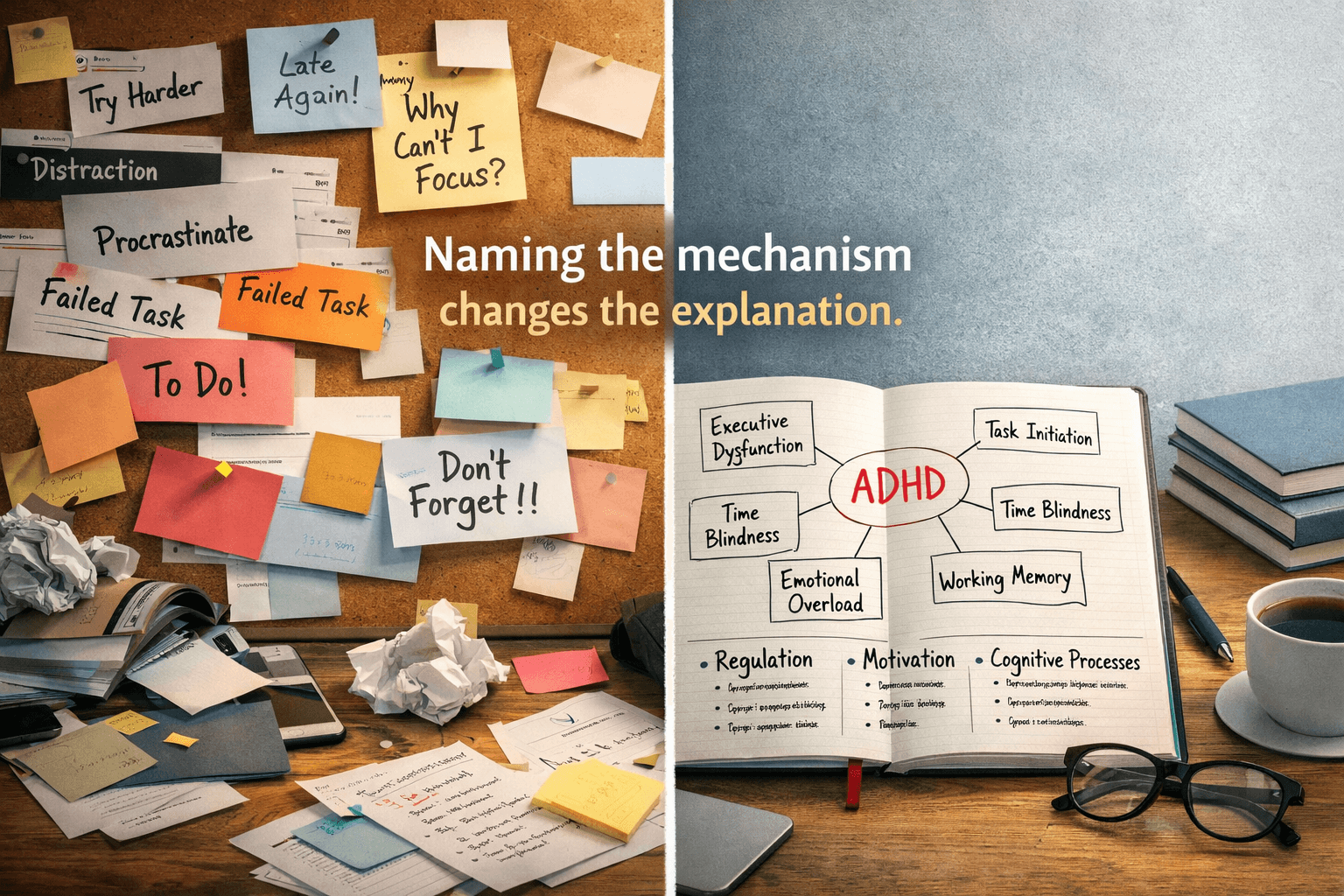
What is usually missing is the mechanism. ADHD is not simply a problem of attention. It is a disorder of self-regulation. It affects task initiation, working memory, emotional regulation, prioritization, time estimation, and the ability to convert intention into action.
People are judged for the visible consequence while the underlying process remains unnamed. Executive dysfunction is called laziness. Cognitive overload is called carelessness. Burnout is mistaken for lack of discipline. Emotional dysregulation is dismissed as oversensitivity.
That gap is why I built ADHDCore.
ADHD Is More Complex Than Most People Realize
The central problem in ADHD is not an inability to pay attention. It is an inability to regulate attention consistently.
Many people with ADHD can focus intensely when something is novel, urgent, emotionally charged, or intrinsically rewarding. The same person may remain unable to begin a routine but important task.
The issue is often described as poor motivation. More precisely, it is impaired task initiation.
Someone with ADHD may want to begin, understand why it matters, feel distressed about delaying it, and still remain unable to start. That is not ordinary procrastination. It is executive dysfunction.
Many adults with ADHD are not outwardly hyperactive. Instead they experience:
- chronic mental restlessness
- difficulty filtering stimuli
- racing thoughts
- emotional intensity
- overwhelm from ordinary demands
- cycles of overfunctioning followed by collapse
Women are particularly likely to be missed because their symptoms are often reframed as perfectionism, anxiety, people-pleasing, or burnout.
Why Most ADHD Advice Fails
Most ADHD advice assumes intact executive function and focuses on habits: planners, routines, reminders, discipline, motivation.
That is why it often fails.
A person who cannot reliably prioritize, estimate time, regulate attention, or initiate action does not need more pressure to “try harder.” They need an explanation of why the usual strategies break down.
- Difficulty starting a task is interpreted as avoidance. It may be impaired initiation.
- Chronic lateness is interpreted as irresponsibility. It may be time blindness.
- Abandoned projects are interpreted as lack of commitment. They may reflect novelty-dependent motivation and cognitive depletion.
- Strong emotional reactions are interpreted as immaturity. They may reflect impaired emotional regulation.
The problem is not only that these experiences are misunderstood. People often internalize the misunderstanding and begin to interpret themselves through it.
What ADHDCore Does Differently
ADHDCore was built to explain the structure beneath the symptom.
Rather than reducing ADHD to a list of behaviors, I wanted to examine the mechanisms that produce them: executive dysfunction, reward-processing differences, emotional dysregulation, sensory overload, masking, burnout, perfectionism, and rejection sensitivity.
The aim is neither to romanticize ADHD nor reduce it to deficit. Both are distortions.
ADHDCore is built around several principles:
- Name the mechanism, not just the symptom.
- Separate impairment from moral judgment.
- Distinguish inability from inconsistency, overwhelm, avoidance, and lack of interest.
- Explain what is common without presenting it as universal.
- Translate research into language that is precise without becoming reductive.
Who ADHDCore Is For
ADHDCore is for people who have spent years being called lazy, careless, dramatic, inconsistent, irresponsible, or “not trying hard enough.”
It is for adults who do not recognize themselves in the stereotype of ADHD.
It is for women whose symptoms were hidden behind achievement, anxiety, perfectionism, overcompensation, or burnout.
It is for parents, partners, teachers, and clinicians who want a more accurate understanding of what ADHD looks like in practice.
It is also for readers who want a single place to follow new research, examine emerging theories, and make sense of findings that are otherwise scattered across academic papers, clinical practice, and lived experience.
What You Will Find Here
ADHDCore focuses on questions that standard ADHD discussions often leave unanswered:
- Why can someone with ADHD do difficult things but not simple ones?
- What is the difference between procrastination and executive paralysis?
- Why are women with ADHD frequently diagnosed first with anxiety or depression?
- Why do many people cycle between overfunctioning, burnout, and collapse?
- What is masking, and why is it so exhausting?
- Why do criticism and rejection sometimes feel disproportionately painful?
- Why do routines work briefly and then fail?
If your experience has never matched the way ADHD is usually described, the problem may not be your experience. It may be the explanation.
Why This Matters to Me
ADHDCore was shaped partly by lived experience.
I know what it is like for ADHD to remain invisible beneath competence, perfectionism, overcompensation, and chronic cognitive strain. To appear functional while struggling with task initiation, inconsistency, overwhelm, and the unreliable conversion of intention into action.
That experience made me less interested in reassuring narratives and more interested in mechanism.
Why do some tasks remain impossible despite effort? Why does conventional advice fail? Why are so many people taught to interpret executive dysfunction as laziness, burnout as weakness, or chronic overwhelm as a personal failing?
ADHDCore grew out of trying to answer those questions precisely.